Additional Pages

Wednesday, 19 February 2014

carpe diem ( and seize the night ! )

The storms have made fieldwork either too unpleasant and or dangerous the last few days. Number of trees down in my local wood is alarming. On the bright side I am wandering if this bit of natural coppicing will improve the light in mini sections, which may have a positive effect on increasing the number of species. Every cloud and all that.

Sunday was decent, the sun was out at last, and so was I. However,away from all but the moist sheltered areas the wind kept the temperature just below that point that may have sprung a goody.
I thought there was a real possibility of some Bee, Drone or Hoverfly activity. I lurked with intent in several likely areas but to no avail.
However, I did find 2 new invertebrates and a nice bit of fugi.

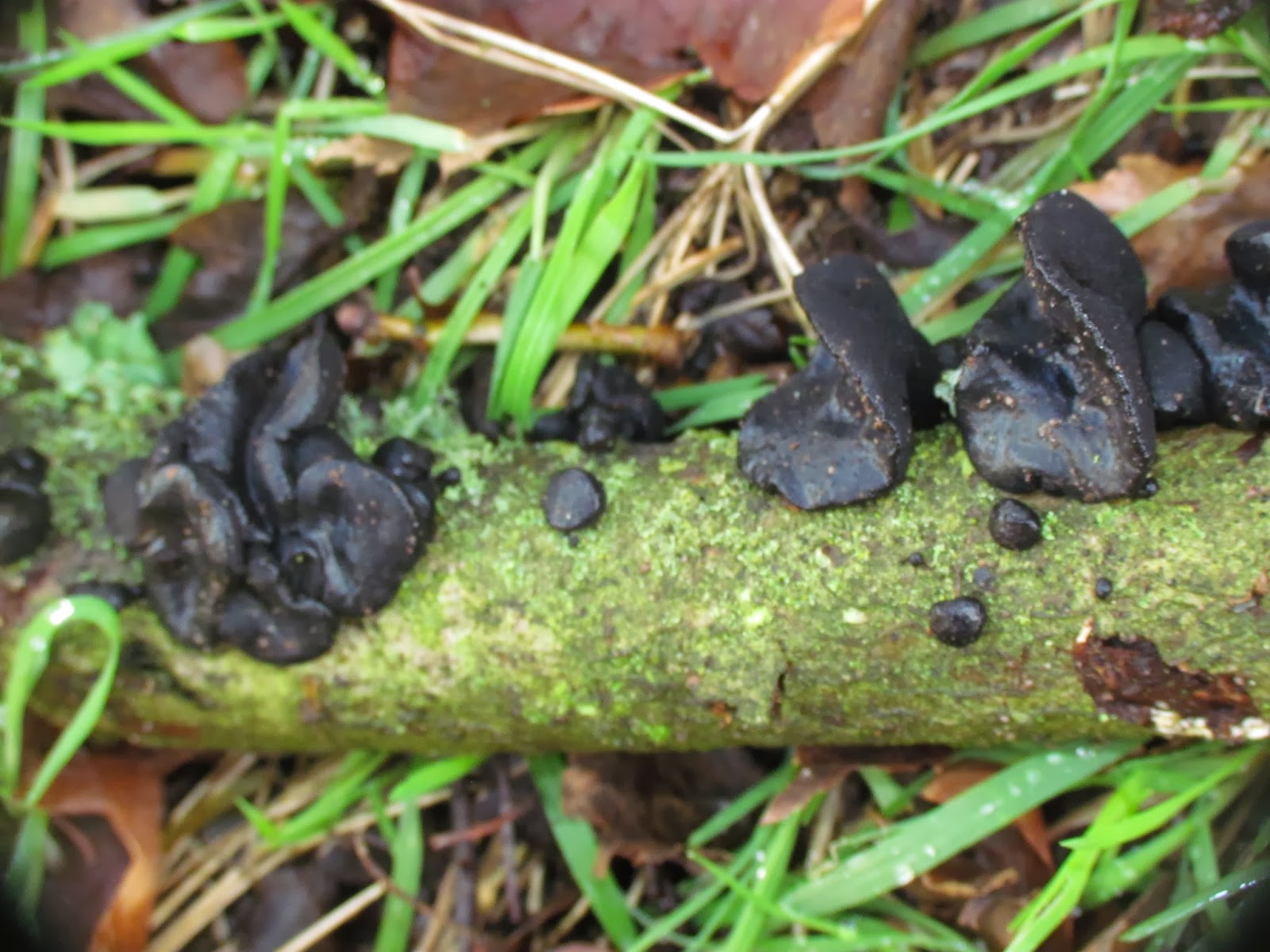
Yellow Brain Fungus

Limonia nubeculosa
This is a  Cranefly that sits with its wings closed.
 The other Invert was a Money Spider  ( Walckemaeria acuminata )

Patch pan list toatal up to 137

With the worst of the stormy weather hopefully now behind us, I have been doing some short runs with the moth trap. My one and only moth to date was a …..Northern Winter |Moth on the 3rd January, a lifer.
I had seen a few fellow trappers had had a bit of luck, so on Tuesday I ran my new MV Skinner trap. I was delighted I managed to bag my target species, the lovely Pale Brindled Beauty. Another lifer for me ! They are, especially for a winter moth, pretty darn smart. .As I would have no chance to photograph it in daylight the next day, I was happy to settle for record shot.

Pale Brindled Beauty ( Garden Trap )


Sill, 2 moths by 19th February is a better start than last year !

Monday, 10 February 2014

Finch- fest boosts wet n windy week 6

Wind.Rain.Mud.
 A brief respite from the crap weather on Monday lunchtime delivered some nice birding. Whilst studying a smallish finch flock, Chaff and Gold,  I scored a couple of Bramblings. This species has been very localised elsewhere in the area this winter, mainly over Lickey way I think. I was not at all hopeful of connecting with any this winter so this was a really good patch find. Bird 56. A pair of Goosander circled the pool but did't put down, and a Cormorant flew over.
A little further on I came across a stonking mixed flock of c75 Siskin and Redpoll.


 And close by a pair of Yellowhammers. I have yet to connect with a single Mipit, Skylark or Linnet or Kestrel on the patch, which is slightly worrying, and I'm not sure if it's the weather or the noticeable increased human and equine activity on the Paddocks every day.
Aside from Brambling, I managed to pick up 4 other additions to the Pan list whilst dodging the rain and gales the previous day.
The surprise was another Spider, Green Orb Weaver, on a Holly bush. He had the red spot by the spinners.


Reluctant as I am to get into the plants before they develop a bit further, it was a case of having too or fail to put any scores on the doors. Thankfully, the internet was there to help, and I managed Lords and Ladies, Small Nettle and Broad-buckler fern.
Species total up to 134

Tuesday, 4 February 2014

Week 5 and digging deep.


No scores on the door for this, but another nice Orange Ladybird find during Weekend 5 of the Patch Bioblitz challenge. It was awake and feeding on a Sycamore.


However, with much foraging, a few morsels were added to the pan listing smorgasbord....

From orange to yellow, the first Yellowhammer of the year was a most welcome addition, I was beginning to wander where they were.
It was hard work again in the wood, and aside from the Ladybird, pretty quiet, but a selective bit of bark bothering brought me 2 nice species of spider. Below is the aptly named Silk Cell or Bark Sac Spider. He was present in his little sack ( the second white patch from the bottom), when he was rudely enucleated and bought home for identification.
 Clubiona corticalis

This was  the result of a similar bark raid the previous day,

Neriene montana
I had used a key in the week, as as far as I could tell, last weeks Springtail looked ok for Orchesella villosa 
I'm lichen this for Evernia prunastri ...

Oak Moss

and a double visit to this fungus satisfied me this was as suggested on ispot, Blackfoot Polypore


Having finally bagged a Rabbit ( well, flushed it), mammal number 4, and totted up a few bits and pieces,  the total has tip toed up to 129. It may be a struggle over the next few weeks until a few more plants make themselves a bit more recognisable, and more inverts appear, but I am really enjoying the challenge.

Monday, 27 January 2014

January finishes with an Invert flourish

The birding continues to be slow, and it was with some relief I finally added another bird to the patch pan list in the shape of a Sparrowhawk on the 25th, and after much lurking in the wood, a Treecreeper finally gave itself up on the 27th. I'm finding myself mainly looking for fungi at present, and this endeavour has produced several species to try and ID. This one is Crepidotus sp. but I'm informed its not possible to nail a definite ID without microscopy. 


The late surprise on 26th, when I thought I may be drawing a blank for the days session, was Scarlet Elf Cup. One small stick holding several examples.
Also found, King Alfreds Cakes and more Witches Butter,  but apparently with a parasitic fungus,  Heteromycophaga glandulosae


King Alfreds Cakes


 Heteromycophaga glandulosae parasitising Witches Butter


Plantwise, Dog Rose and Daisy ( Bellis Perennis) were noted too.

The Highlight of the weekend was undoubtedly finding an Orange Ladybird. It was hibernating on the trunk of a Sycamore, sheltering under a branch. This was a ladybird lifer for me, very pleasing to find.


My invertebrate roll continued, with a Lace Weaver Spider revealing itself on some loose bark. A bit of further reading suggested that, given the habitat, this was highly likely to be Amaurobius fenestralis rather than A. Similis.


A hatrick of invertebrate additions was scored late in added time on the 26th, with the final kick of a fallen log revealing a Woodlouse. I realised this one was different to my previous Common Striped, and indeed it turned out to be Common Shiny Woodlouse.


This Springtail was a nice find on a fence post on the 27th, I'm working on a definitive ID, maybe  Orchesella villosa or Entomobrya intermedia..or summat.


I also nabbed a Centipede, but nailing an ID on him may not be possible, but I'm working on it. Just when I thought I had bought all the Field Study Council Keys I would need too !
So,  a pleasing and interesting mixed bag  for the weekend, taking the total for the year and January to a 120 with a few on the back-burner.

Sunday, 19 January 2014

Plodding through the Snowdrops

I was well aware that the pan listing would get tougher after the initial flurry during this month. Its been very quiet on the birding front this weekend, with not a single species added, despite trying very hard to dig out a Treecreeper, Mipit or even a Kestrel. I did two 3 hour sessions strolling around the patch, and here are the key finds.
  The first flowering  Snowdrops of the year !


Also found in flower was this Lesser Periwinkle


The only other plants I identified were Reed Mace and Duck Weed ( I was getting desperate on Saturday). Still, they all count.
The only creature I added was this Leopard Slug, but that's the beauty of pan listing, at least I'm finding stuff, and stuff I've never seen before. If I was purely birding, it would be a very dull and unchallenging month

Limax maximus

On the Fungi front I had forgotten the name of Coral Spot until fellow local pan-lister flagged some up on his blog ( Cheers JK ;0 )
It was one waiting in the wings so can now go on the list.
One I hadn't heard of, was the White Brain Fungus, and it was with interest I saw this had only been recorded in the county 18 times previous the Shenstone find. I am happy to add the 20th record for VC37, having spotted this tiny fungi myself in the wood shortly after the Snowdrop find.


I had walked past this many times and wandered what it was. Whilst reading my Gall book the other day I noticed an almost identical picture to one I had taken last week. It's a Crown Gall caused by Agrobacterium tumefaciens

Crown Gall on Birch
Considering the lack of avian additions, and the weather, I was quite satisfied with 10 additions to last weeks total, especially the diversity and some new species learnt about.

Species Total 110

Sunday, 12 January 2014

100 up , Celebrations cancelled

A perfect winter birdwatching day on Saturday, great light, blue skies. A 5 hour shift on the patch produced half of bugger all. Ok, not quite, as there was a Great Crested Grebe on the fishing pool, which is pretty unusual for January. Aside from that, eventually snagged a Goldcrest and a got eyes one of the few House Sparrows that populate the designated patch for the bioblitz.I can't remember the last time I birded the patch on a such a day and failed to see a single Buzzard or Green Woodpecker. Very odd.
I added Crab Apple, that I knew I had, but actually found another.Cherry Laurel too. Fungi-wise, a few more noted, ID's to be worked on.

Through the week I had processed and confirmed, a few including the Fungi Witches Butter

Utterly unbutterly

and Purple Jelly Disc


and a new plant for me, Wood Sage

Wood Sage

The sun brought out a Yellow Dung Fly, and a walk through the wood revealed an unexpected Red Campion in flower.
Red Campion..100 UP 


Sunday was dire.


So with additions from the weeks homework, I moved up to 100 species...yea !


So why the downer ? Well, I was pretty pissed off a few weeks ago to see the set aside had been given a grade 1 haircut. This was presumably because the footpath was getting a bit narrow, but the response had all the finesse of an ataxic Edward Scissorhands. I tried to consolidate myself that hither too dormant species of plant may show now the lighting had improved. However , on Saturday I noted  Edward had returned and aimed his reaper at anything pointing horizontally up to about 2 meters. So, after an excellent lepidoptera year, a substansial number of eggs will have been obliterated, including this Purple Hairstreak one I found the other week. I wish I had snipped it off and reared it now.

RIP Purple Hairstreak August 2013-Jan 2014.


Birds 52
Plants 23
Fungi 15
Mammals 3
Diptera 2
Woodlice 1
Galls 3
Coleoptera 1

Sunday, 5 January 2014

Pan Listing Begins with good birding !

A great start to the Pan listing year. I have quickly confirmed the presence of a few species I knew were about, stuff like a few  fungi, lichens, some common trees and plants. Stuff that, baring something major, would still be present come New Years Day.

Wrinkled crust

The Poor weather on New Years Day proved a blessing. Braving the elements it was clear a lot of birds were pinned down. The fishing pool held Tufted Duck, Goosander, 3 Mute Swans ( actually very rarely seen on the patch) but not as rare as a grounded Merlin, which I stumbled across nearby ! ( no sign since) The adjacent fields held a good mixed flock of winter thrushes, including the first Fieldfares actually on the deck this winter.

Patch rarity

 The following day, another patch mega, I flushed a bird whilst slightly "off road" in the wood, which I watched fly away low and straight deeper into the wood. A Woodcock !
The session got even better when I spotted a very fine Red Fox going about his business
The New Years birding carried on being good. A flock of c30  Lesser Redpoll were the first of the winter, with a few Siskin mixed in for good measure. The Kingfisher gave itself up nice and early in the year too, rapidly getting me up near 50 on my birdlist. I usually average around 55 for January.
Apart from 7 spot Ladybird, I was able to add another species from the walk , the Fly, Photomyza ilicis aka Holly Leaf Minor, and the mine contained the pupae of the fly.Two species for the price of one !

Holly Leaf Mine with Pupae of the  fly Phytomyza ilicis


Back to fungi, a lot found on the 4th. This one I had read about as being fairly common on Ash, but need to revisit it

Anthonia Radiata/Lecidella elaeochroma


 Was pleased to find a new one for me, a Knopper Gall induced by a gall wasp, Andricus quercuscalicis. Looking forward to lots more varieties later in the year. I'm counting them as evidence of causative species if  organism not found.

Knopper Gall


So, a nice solid start, approaching 100 species and a few in the 'To ID' box for those dark after work evenings. It's going to get harder but looking forward to the challenge !
 For a list of all species, check the species recorded page, which I will update every week or so, and tweak as necessary if I have doubts about definitive ID's.

Birds 49
Fungi  12
Mammals 3
Flies 1
Plants 18
Woodlice 1
Beetles 1
Galls 3